





















What it describes
Autogynephilia is a natal-male sexual orientation involving arousal to the thought, image or fantasy of oneself as female. It is inwardly directed gynephilia: the female self is the erotic target.
Read the framing essaySexual orientation / developmental expressions / evidence
Promoting education and positive awareness of autogynephilic sexual orientation, gender expression, identity, and dysphoria.
Research, clinical synthesis, and public first-person accounts for people with autogynephilia, their partners and families, clinicians, researchers, and others seeking an evidence-based account of the orientation and its developmental expressions.
AGP in 60 seconds
Autogynephilia is the core sexual orientation. Gender expression, gender identity, partner interest, embodiment wishes, dysphoria, and transition are possible secondary expressions or outcomes.
Autogynephilia is a natal-male sexual orientation involving arousal to the thought, image or fantasy of oneself as female. It is inwardly directed gynephilia: the female self is the erotic target.
Read the framing essayIn the autogynephilic pathway, the orientation generally precedes and can cause or contribute to female-embodiment desire, female identity, gender dysphoria and transition desire. Erotic and affectional reinforcement of the female self connects the orientation to these developments; identity or dysphoria does not create AGP.
AGP is the underlying orientation; partner interest, gender expression, identity and dysphoria are distinct dimensions of its development. True/exclusive androphilia is the separate non-AGP natal-male pathway. Among autogynephilic people, the intensity and forms of expression vary.
Erotic target identity inversion theory
The model proposes that an attraction usually directed toward another person can, in a small subgroup of natal males, also be experienced as attraction to being or becoming that erotic target.
Attention and arousal are directed toward the desired erotic target.
Arousal includes imagining oneself as, or imitating, the erotic target.
The erotic target is internally represented in relation to the self.
Most common form predicted by this framework
Because gynephilia is the most common outward-directed attraction among natal males, the model predicts autogynephilia to be the most common erotic target identity inversion.
This is a population-level prediction about relative frequency. It does not mean that gynephilia ordinarily becomes autogynephilia.“This theory predicts that, for every class of sexual object, there will be small subgroups of men who develop fetishes for clothing associated with the desired object, who develop the erotic fantasy of being the desired object, and who develop the sustained wish to transform their own bodies into facsimiles of the desired object”
Quoted verbatim; the source’s terminology reflects its publication period.
Core conceptual position
Autogynephilia is the core sexual orientation and underlying neurological disposition in this developmental model. Gender identities, relationship patterns, gender expressions, embodiment wishes, and clinical outcomes are secondary elaborations shaped over time by interacting biological, psychological, interpersonal, and social factors.
Private self-profile for adult natal males
Complete the published 22-item General Autogynephilia Scale and see your overall score and five subscales beside descriptive values from the original study.
Not a diagnosis: results describe your answers and compare them with two specific research samples. They do not determine identity, dysphoria, treatment, or transition decisions.
One core sexual orientation, varied developmental expressions
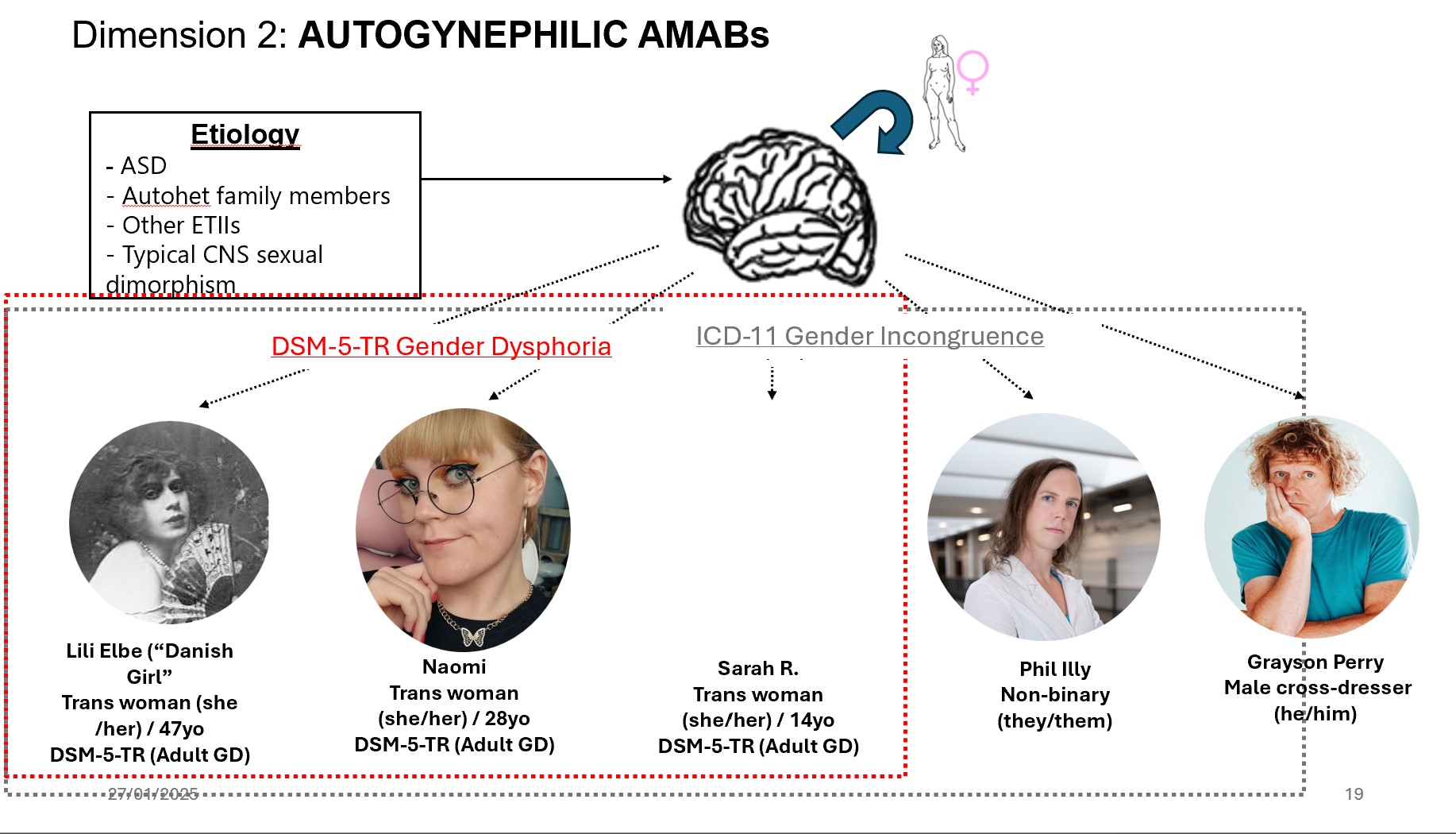
These profiles show how the same core orientation can develop into different configurations of partner interest, gender expression, gender identity, embodiment, dysphoria, and transition. An autogynephilic bisexual cisgender man and a fully medically transitioned autogynephilic transgender woman can share the orientation without having the same identity, body, relationship pattern, or clinical experience. Biopsychosocial factors shape these configurations; they are not stages or a hierarchy.
Example profile
A cisgender man may cross-dress, express femininity, or develop autogynephilic bisexuality, in which interest in male partners is secondary to arousal to being a woman. Gender dysphoria may be minimal or absent.
Example profile
Some integrate reinforced female or feminine self-states into nonbinary, gender-fluid, femme, femboy, sissy, cross-dresser, or other self-descriptions.
Example profile
Some develop persistent, clinically significant discomfort or distress in the male role or body and identify as transgender women; social and medical transition may follow.
Faces & voices
These accounts document different identities, relationship patterns, gender expressions, embodiment choices, and experiences of dysphoria. They are individual first-person accounts, not prevalence evidence.
First-person lived experience
Curious
Taftaj
Sasha Fem Reznov
Ashley Adamson
Surge Doll
Zack M. Davis
First-person account
Ray Williams
Hunter Ash
First-person account
Expert and research conversations
These conversations are separated from first-person accounts so their role is clear.
Dr James Morandini
Dr Anne Lawrence and Dr James Morandini
Dr Michael Bailey

Dr Kevin Hsu
Written voices and books
These sources are labelled as clinical synthesis, first-person framework, lived-experience commentary, or peer-reviewed empirical research; they are not treated as equivalent forms of evidence.
Dr Anne Lawrence
Phil Illy
Kay Brown
Morandini, Hsu & Rudd
Public community posts can be added when a stable permalink and approved display title are available; use short, respectful context rather than screenshots or long extracts.
Curated Zotero collection
Collection key CM3C379Y. Items outside this collection are excluded. The current snapshot contains 71 collection items represented as 70 deduplicated bibliographic records.
71items in selected collection
70deduplicated records shown
55journal-article records shown
64records with substantive indexed PDF text
1972-2025chronological span
Prince & BentlerSurvey of 504 Cases of Transvestism reported questionnaire findings from male cross-dressers and identified limitations including sample selection and the absence of a control group.
Blanchard administered androphilia and gynephilia scales to 163 male-to-female transsexual patients and compared sexual-orientation clusters.
Blanchard introduced autogynephilia and tested its relationship to nonhomosexual male gender dysphoria in a clinical sample.
Docter & Prince reported questionnaire data from 1,032 cross-dressers.
Hsu, Rosenthal, Miller & Bailey found that AGP-recruited male cross-dressers showed a distinct sexual arousal pattern that was neither homosexual nor identical to the control pattern.
Bailey, Hsu, Morandini and colleagues tested female comparison claims, measurement and AGP in bisexual cisgender men.
All 70 deduplicated records, oldest first
Search by title, author, decade, source format and lawful access. Source-format labels do not by themselves establish empirical design, peer review, or evidential weight.
The evidence, card by card
Each card states what was studied, the main finding, and the boundary of what the source can establish.
Bailey & Hsu / Archives of Sexual Behavior
Morandini, Hsu & Rudd / Archives of Sexual Behavior
Hsu, Rosenthal, Miller & Bailey / Archives of Sexual Behavior
Hsu, Morandini & Rudd / Clinical Psychological Science
Savic & Arver / Cerebral Cortex
Manzouri & Savic / Cerebral Cortex
Cantor / Archives of Sexual Behavior
Moser / Journal of Homosexuality
A 2025 conference presentation by Hsu and Morandini reported a small association between AGP classification and elevated AQ-10 autistic-trait scores across targeted and Prolific samples. AQ-10 is a screening measure: these results do not diagnose autism or establish causation.
Published history and cross-cultural research
Lawrence’s published analyses found a greater proportion of nonandrophilic trans women in more individualistic societies, broadly corresponding to a Western–Eastern contrast. Within the typology examined, this is interpreted as greater representation of the autogynephilic pathway. The studies did not directly measure AGP prevalence in national populations.
Blanchard’s published historical review documents clinical descriptions, from the beginning of the twentieth century, of males aroused by imagining themselves as women. Earlier terminology centred on transvestism, although the described erotic interests extended beyond clothing to female anatomy and other aspects of being a woman.
Historical review: Blanchard (2005), Early History of the Concept of Autogynephilia. Archives of Sexual Behavior, 34, 439–446.Blanchard introduced autogynephilia as a concept describing a male’s erotic arousal to the thought or image of himself as a woman. His paper placed this erotic interest within a typology of male gender dysphoria. The erotic interest and gender dysphoria are distinct constructs: the definition of AGP does not itself require distress or transition.
Concept and typology: Blanchard (1989), The Concept of Autogynephilia and the Typology of Male Gender Dysphoria. Journal of Nervous and Mental Disease, 177, 616–623.Across 22 studies from 16 countries, Lawrence found a strong association between societal individualism and the proportion of nonandrophilic participants in transsexual or gender-dysphoric samples (r = .88). Such participants were generally more represented in Western samples than in several Eastern samples. This association does not establish that individualism causes AGP.
Cross-study analysis: Lawrence (2010), Societal Individualism Predicts Prevalence of Nonhomosexual Orientation in Male-to-Female Transsexualism. Archives of Sexual Behavior, 39, 573–583. Read the paper (PDF).In a published follow-up letter, Lawrence analysed seven additional samples and again found an association between societal individualism and the proportion of nonandrophilic trans women (r = .85). The finding supports a cross-cultural difference in the composition of the samples studied; it does not establish a universal division between Western and Eastern people.
Follow-up analysis, letter to the editor: Lawrence (2013), More Evidence that Societal Individualism Predicts Prevalence of Nonhomosexual Orientation in Male-to-Female Transsexualism. Archives of Sexual Behavior, 42, 693–695. Read the letter (PDF).This section uses published sources. Historical clinical descriptions, sexual-orientation classifications and direct measurement of autogynephilia provide different kinds of evidence and should not be treated as interchangeable.
Explore the research library →Beyond the culture war
AGP is misrepresented when it is used to infer bad character or dangerousness, and when it is denied or redefined to avoid those hostile uses.
Some gender-critical and socially conservative commentary uses AGP to infer bad character, deception, or dangerousness, or as a categorical argument against transition or access to female spaces.
Recent tabloid spectacle around alleged private cross-dressing shows the pattern. Cross-dressing does not establish AGP, and humiliation is not education.
AGP is an erotic orientation with explanatory relevance to female-self attachment, embodiment wishes, identity and dysphoria in the autogynephilic pathway. Those developmental effects are distinct from moral character or dangerousness.
Some trans-affirming commentary denies AGP, treats its terminology as illegitimate, or equates it with ordinary female sexuality. These positions obscure the distinct sexual orientation described in natal males and remove language used by people who recognise it in themselves.
Not every critic denies the underlying experience. Transgender Map, for example, now says its dispute concerns the term and interpretation. This site disagrees while describing that position accurately.
Read the supplied context
Lawrence: Autogynephilia as Thought Crime Dreger: a case history of the politics of science and identity Example of the terminology disputeEditorial rule: We criticise claims, not identities. We do not infer anyone's private sexuality from appearance, politics, cross-dressing or transgender status.
New specialist pathways
Clear psychoeducation for young people and parents, plus source-labelled visual explainers drawn directly from the specialist materials on this site.
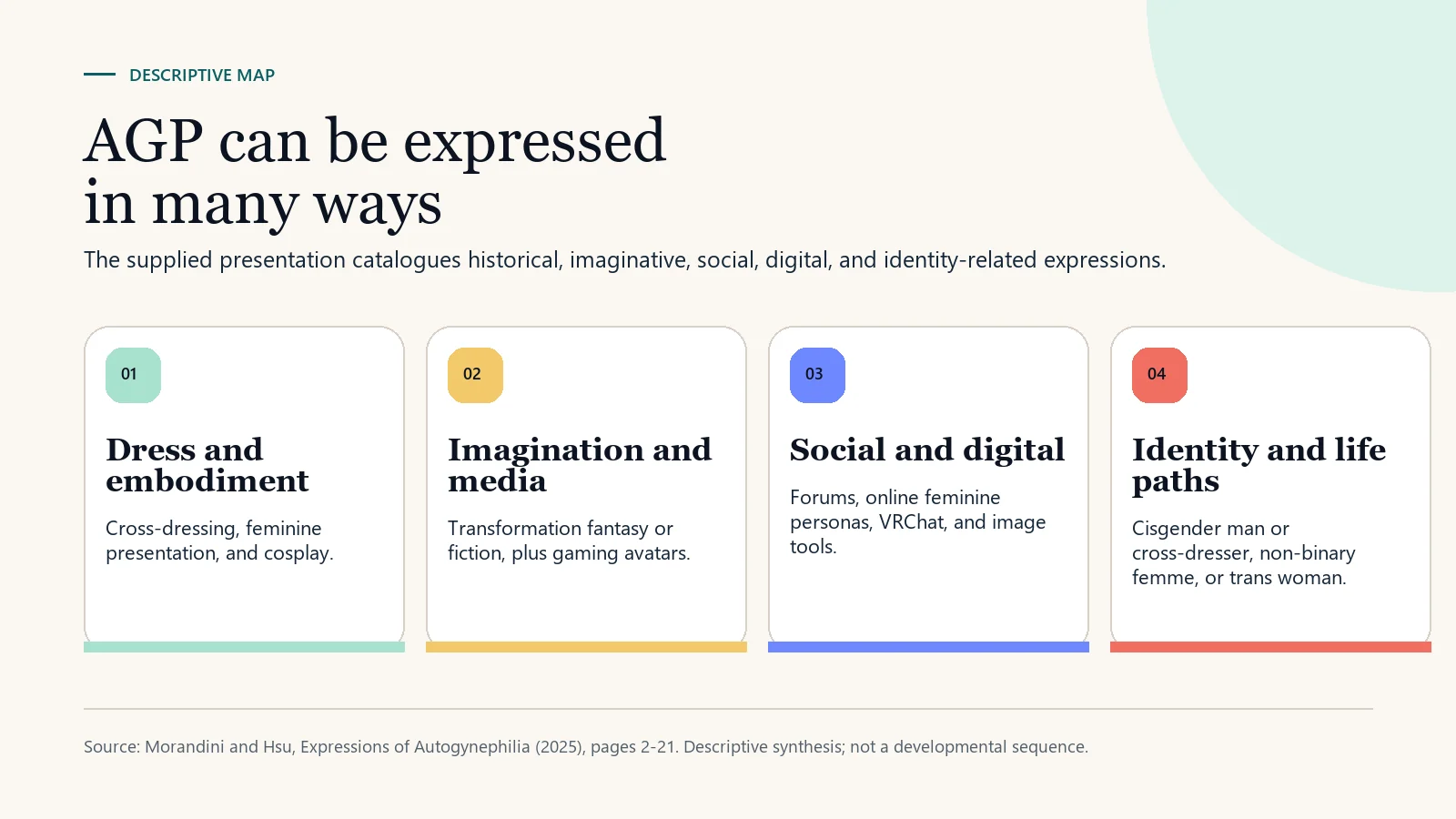 03 Visual guides Orientation, expression, identity, and dysphoria are distinct. Explore descriptive expression maps, proposed clinical pathways, and a clearly labelled testable brain hypothesis. Explore the visual guides
 Editorial boundary: descriptive material, clinical formulations, hypotheses, and empirical findings are labelled separately throughout.
Choose your starting point
Choose the section for autogynephilic people, partners and families, clinicians, or researchers.
Start with AGP as the core sexual orientation, then distinguish its possible secondary effects on partner interest, gender expression, embodiment wishes, gender identity, and dysphoria. First-person accounts illustrate different developmental outcomes; no single account defines the orientation.
Compare distinct developmental outcomes ->AGP does not by itself determine identity, transition, fidelity, or the future of a relationship. Assess the individual’s partner-directed attraction, autogynephilic bisexuality, disclosure, dysphoria, transition goals, and relationship agreements.
Return to the core definition ->Assess the core autogynephilic orientation and its developmental sequence: erotic and affectional attachment, female embodiment, identity and dysphoria. Characterise each dimension alongside partner interest, functioning and relationships. Establish the individual pathway through history and convergent evidence, not a label alone.
View clinical conversations sourceKeep construct validity, recruitment source and comparison groups visible. Separate direct AGP measurement from typology-based inference and label commentary, preliminary results and lived experience for what they are.
Return to the evidence cards ->About the project
The site collates peer-reviewed research, historical sources, clinical synthesis, clinician-authored psychoeducation, and public first-person accounts for autogynephilic people, partners and families, clinicians, and researchers.
Continue with the evidence