Descriptive source
Open the expressions PDFExpressions of Autogynephilia
Morandini and Hsu, 2025. The source presentation behind the spectrum overview and six expression cards.
Visual guides
Autogynephilia is the underlying sexual orientation. The supplied clinical and educational materials describe secondary expressions involving clothing and presentation, imagination and fiction, digital embodiment, online community, relationships, gender identity, dysphoria, and transition.
The page separates the core orientation from descriptive expression domains, clinical formulations, developmental outcomes, and an untested neural hypothesis.
Descriptive source
The supplied presentation catalogues physical, imaginative, social, digital, and identity-related expressions of autogynephilia. These are secondary elaborations of the orientation, not alternative definitions.
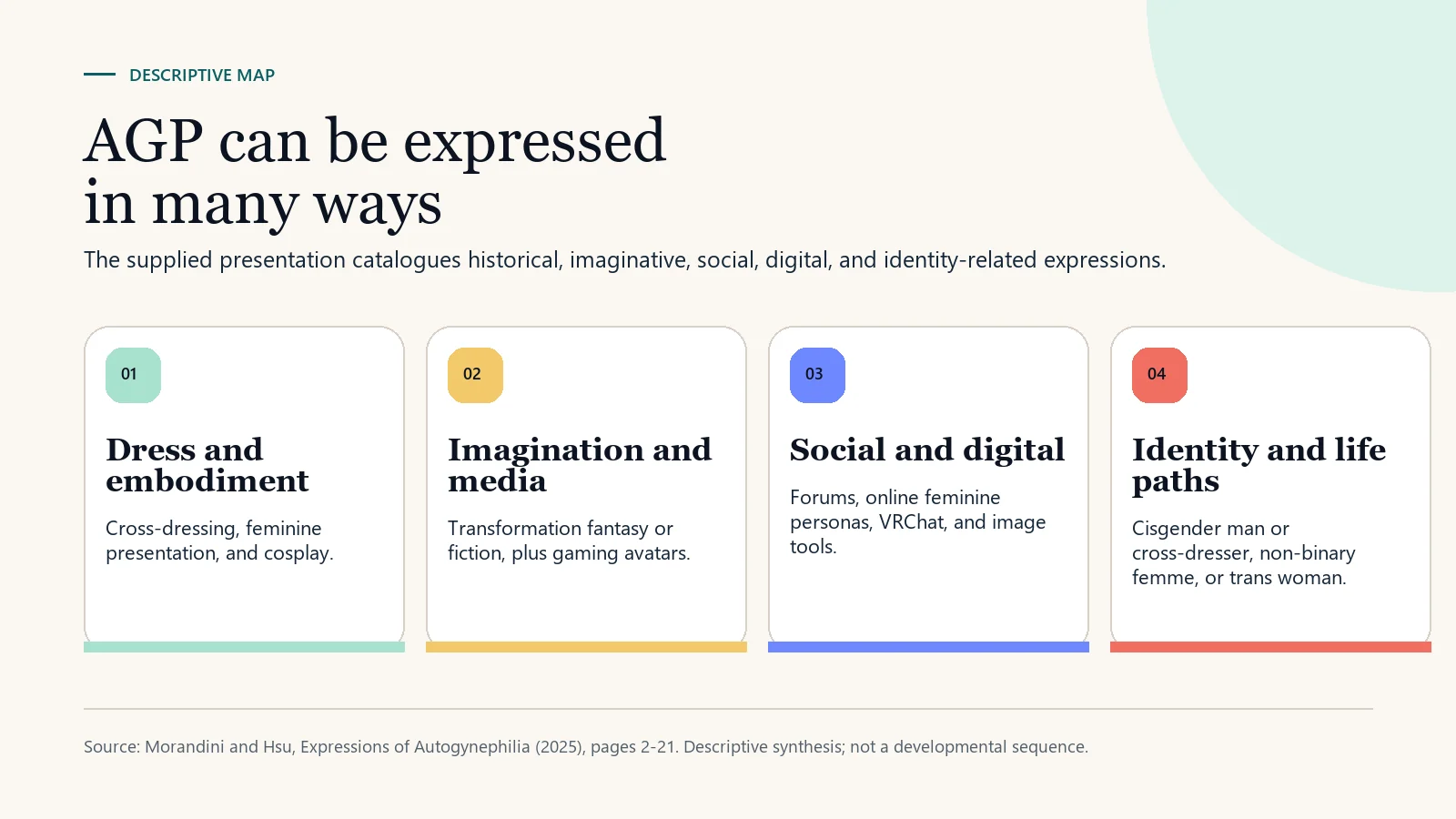
The map brings together physical, imaginative, social, digital, and identity-related possibilities described in the supplied presentation. It is a catalogue, not a sequence.
Interpretive boundary: The categories are partly independent and do not form a single continuum or developmental sequence. They do not by themselves establish AGP.
Descriptive source
These cards organise examples from the supplied Expressions of Autogynephilia presentation. They describe possibilities; they are not diagnostic criteria.
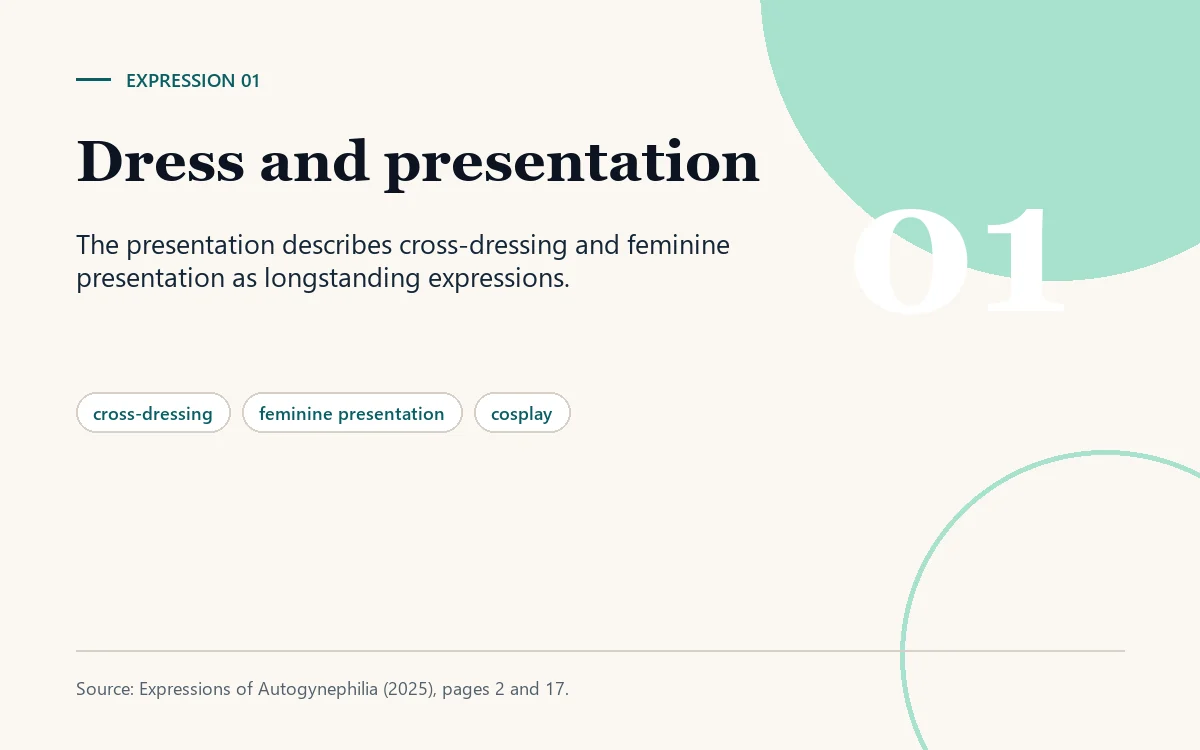
Cross-dressing and feminine presentation are longstanding forms of expression. The presentation also includes cosplay as a contemporary form.

Transformation fantasy and fiction can provide an imaginative way to experience or explore a female self.
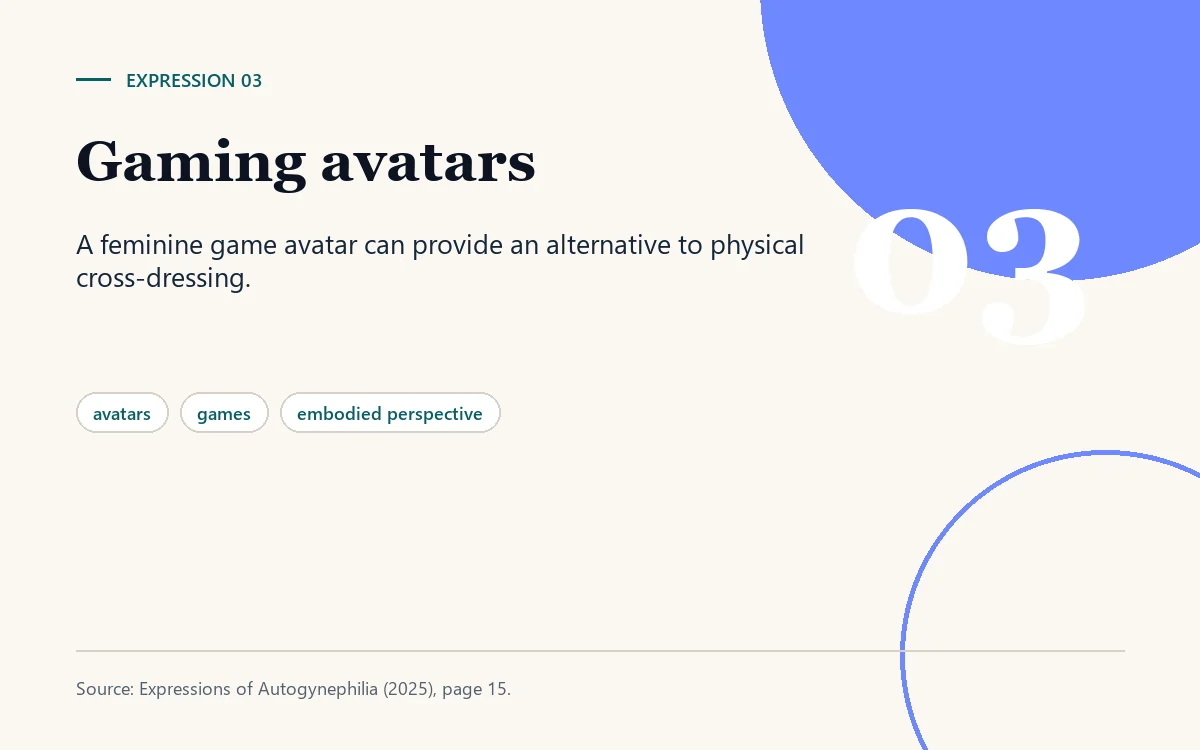
A feminine game avatar can provide an alternative to physical cross-dressing and a way to experience a female perspective in a digital setting.

VRChat and other virtual environments can support feminine embodiment or presentation.
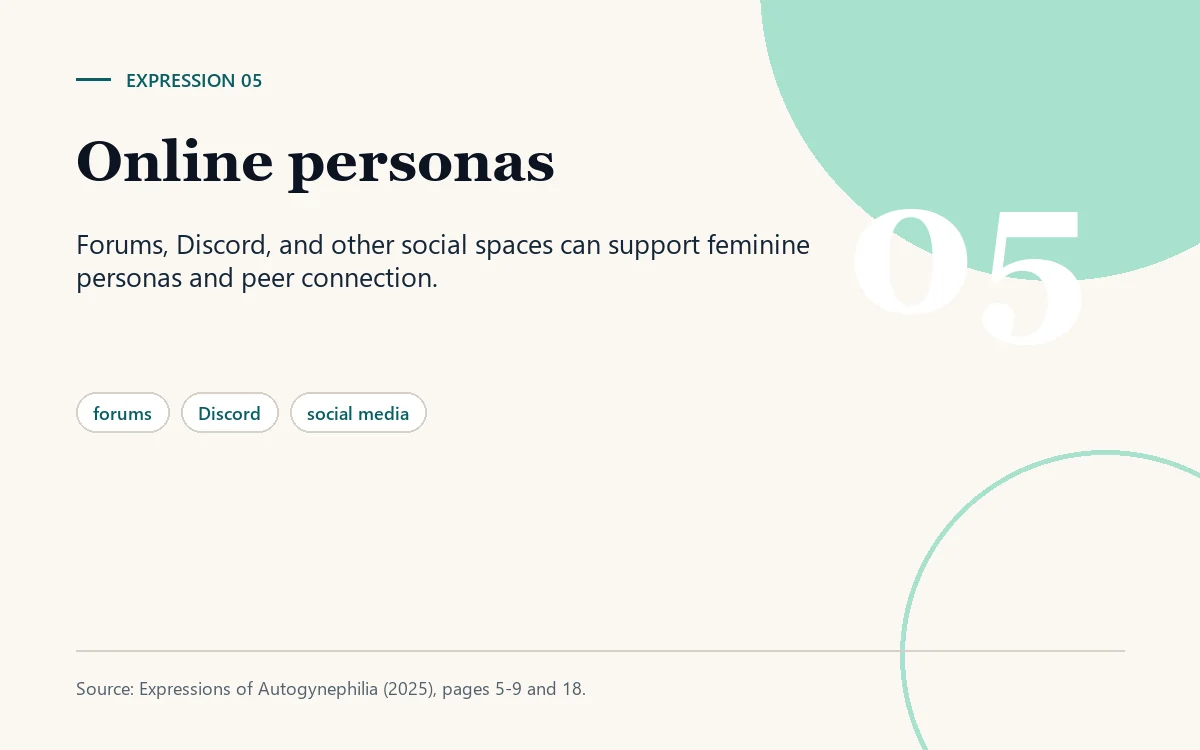
Forums, Discord, and other social spaces can support feminine personas, conversation, and connection with other people.
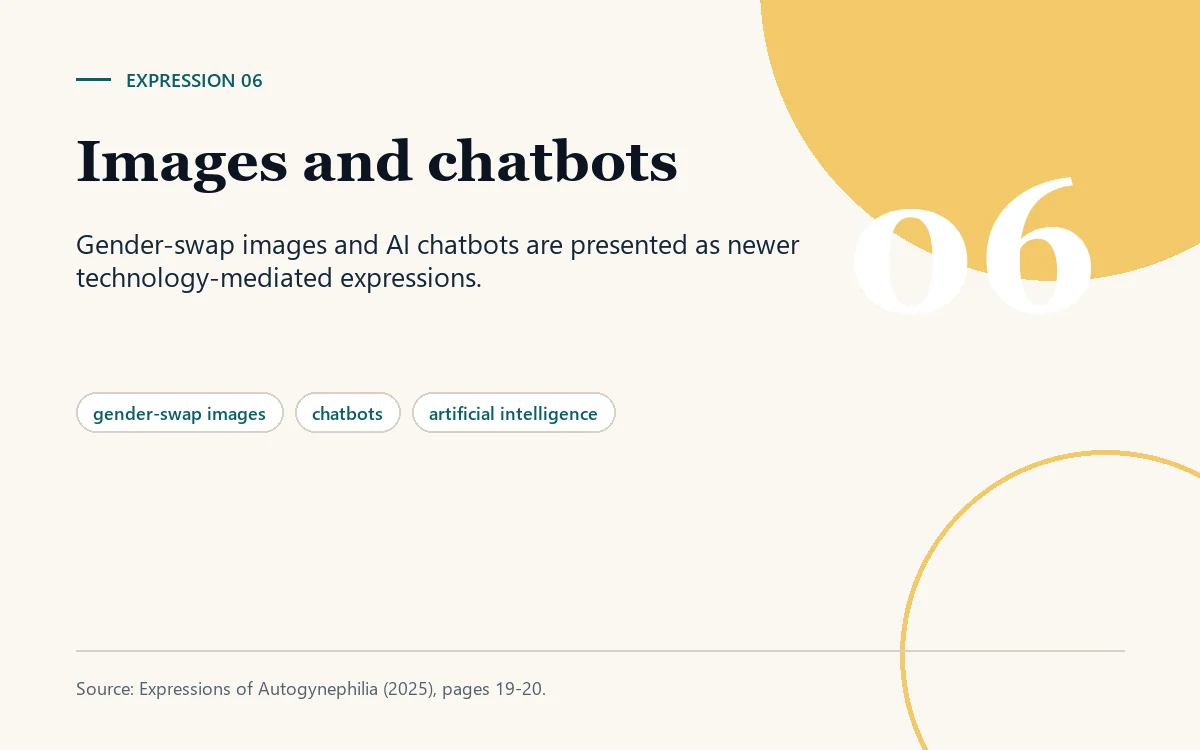
Gender-swap images and AI chatbots are presented as newer technology-mediated expressions.
The derivative cards avoid reproducing raw usernames, social-media posts, identifiable faces, or third-party screenshots from the source presentation.
Youth and family formulation
The youth presentation offers two clinical frameworks for organising careful questions and support. Neither is a diagnosis, a single-cause explanation, or a prediction of an individual's outcome.

The youth presentation places AGP-related gender dysphoria within a biopsychosocial formulation. It invites consideration of individual factors, family and peer context, services and media, and wider cultural beliefs. The purpose is to organise careful questions and support, not to assign a single cause.

Within the presentation’s proposed model, AGP is treated as necessary but not sufficient for later gender dysphoria. Outcomes range from little or no dysphoria to persistent dysphoria, and from cisgender or cross-dressing lives to non-binary or transgender identities.
The model is not a fixed sequence and should not be used to predict an individual's outcome.
Morandini proposes two partly independent neural "dials." In the model, a more permissive self-other gate allows some female representations to carry a self tag, while a stronger self-to-arousal route lets that self state more directly engage sexual drive. Together, these parameters could make self-as-female imagery intrinsically arousing, with later experience potentially amplifying it.
Evidence boundary
The post proposes a mechanism and a set of behavioural, imaging, physiological, and causal tests. It does not report the results of those tests.
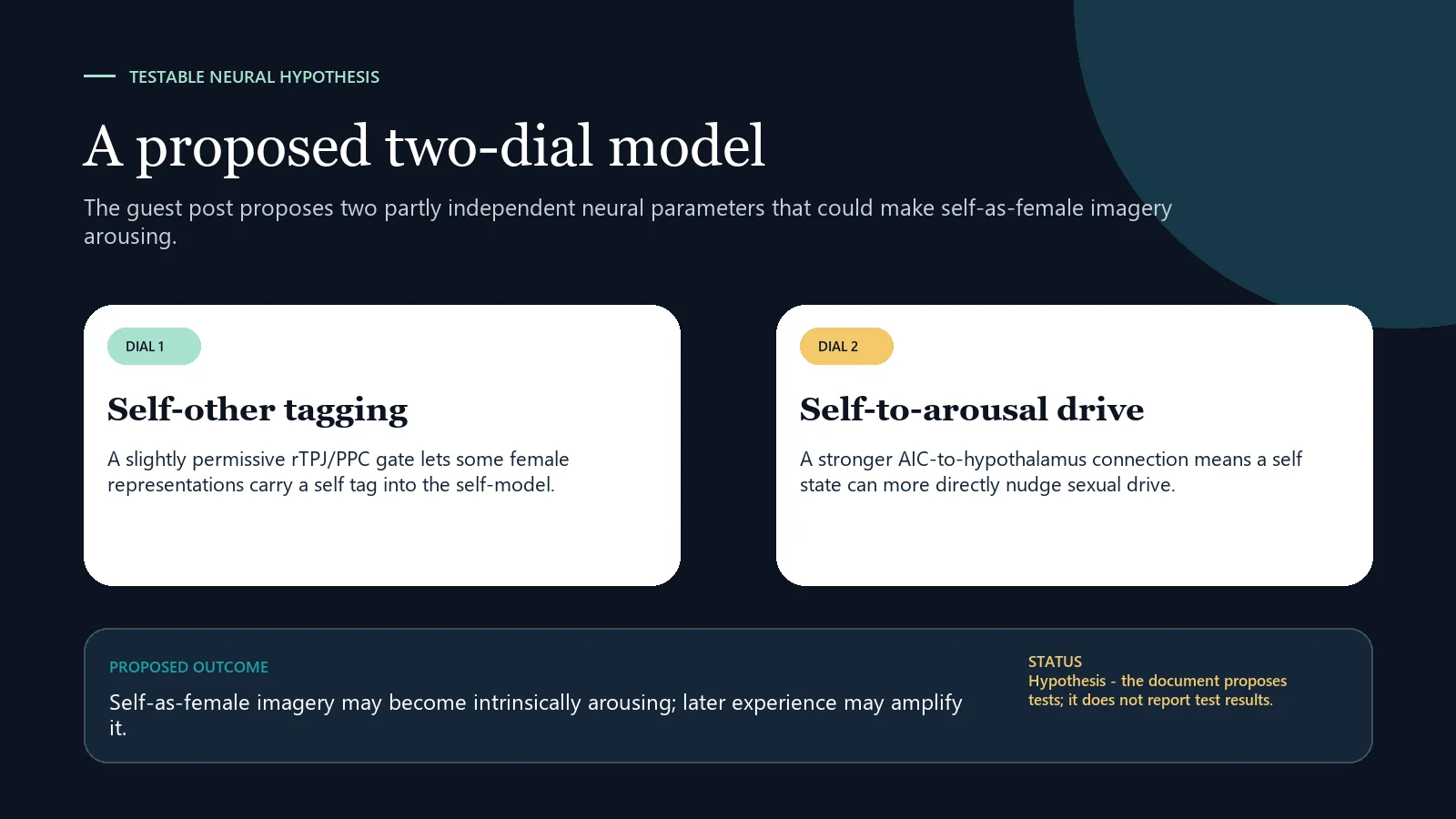
One dial concerns self-other tagging. The other concerns the route from a self state to arousal. The model proposes how their combination could be studied.
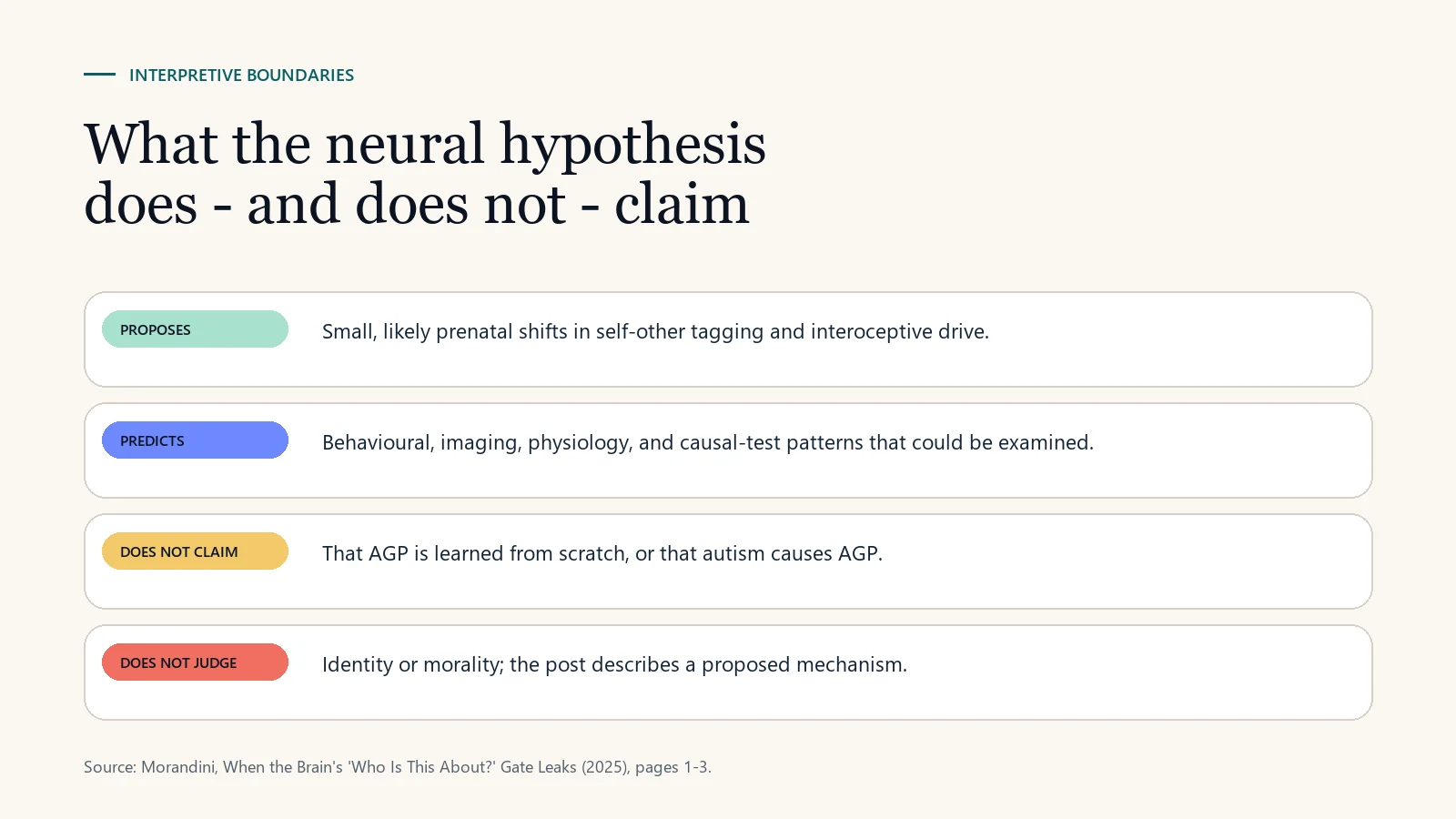
The post is not a moral judgement about identity. It does not claim that AGP is learned from scratch, and it does not claim that autism causes AGP. It treats certain neurodevelopmental features as a possible risk lens and makes predictions that could be tested.
Read the full hypothesisRead the supplied sources
These documents provide visual explanation, clinical framing, and hypotheses. Use the research library for statements presented as empirical findings.
Morandini and Hsu, 2025. The source presentation behind the spectrum overview and six expression cards.
Morandini, 2025. The proposed two-dial mechanism, interpretive boundaries, and testable predictions.
Morandini, 2025. The source presentation behind the biopsychosocial and non-deterministic pathway visuals.
Editorial safeguard
The visual guide excludes raw case-level material, uncorrected presentation percentages, public self-test heuristics, usernames, identifiable faces, and third-party screenshots from the supplied presentations.
Keep exploring
Use the age-appropriate guides for practical support, or move into the specialist-curated research library for empirical findings.